A GUIDED TO ITALIAN CUISINE :
ITS History, Flavors, and Influence on American Cooking
By : chef ssentongo Geoffrey
Of all the world cuisines, perhaps nothing has impacted the American culinary scene as much as Italian food. The two are so closely linked that you might forgive some folks for thinking pizza or spaghetti and meatballs are as American as hot dogs and apple pie.
And in many ways, they are quintessentially American—spaghetti and meatballs, for example, are an adaptation created by Italian immigrants who took recipes they brought from home and adjusted them based upon ingredients that were available in the U.S.
Join us on a cultural and culinary journey to explore the rich history of Italian cuisine and how it became woven in the fabric of our meals in the U.S.
All Roads Lead to Rome: The Origins of Italian Cuisine
Italian food can be traced to ancient Rome, where the cuisine was a far cry from what we associate with Italian food today. They used copious amounts of fish sauce as well as cumin and coriander, but very little garlic and basil. They also consumed so much silphium, an extract of a giant fennel plant, that they helped drive it to extinction.
Trade routes with Arabs, established around the first century BC, brought citrus and spices. The Romans also revered peppers so much that the earliest known cookbook, Apicius, with recipes by Roman Marcus Gavius Apicius, includes pepper in 349 of its 469 recipes. Those recipes also include a lot of garum, or fermented fish sauce, as well as laser, extracted from silphium.
“Those rich sauces and accompanying spices were typical of the sophisticated and elaborate cuisine of the Roman empire, which bears little resemblance to 21st-century Italian food,” according to Britannica.
After the fall of the Roman Empire in 476 CE, the Middle Ages featured a medieval European cuisine that was largely homogeneous, with a flavor profile that was closer to what we think of as Thai or Indian food today.
“Medieval European cuisine as a whole seems to have had little regional variability— the Italian cookbooks of the era contain recipes that are virtually indistinguishable from those of France, England, and other European countries,” according to Britannica.
The Middle Ages lasted about 1,000 years by which time, regional influences had started to emerge. In the 15th Century, when Europeans discovered the Americas and the Caribbean, or the “New World,” Italian cuisine began to change dramatically with the introduction of tomatoes, potatoes, bell peppers, corn, and cocoa. Surprisingly, Italians took a while to embrace tomatoes, which became more commonplace in Italian cuisine in the late 17th century.
A Patchwork Cuisine With Peasant Origins
Italian cuisine has distinct regional influences:
- North (where the Alps are): butter-based dishes and rice
- Central (Tuscany): pasta, olive oil, bread
- South (toward Mediterranean Sea, including Naples): tomatoes, seafood, and citrus fruits.
- Sicily and Sardinia: island influences
The political environment also lent itself to a variety of cuisines. Again, from Britannica: “Until Italy was unified as a country in 1870, the area was a patchwork of duchies, principalities, city-states, republics, and territories controlled by foreign monarchs. There was no permanent or centralized Italian monarchy and thus no royal court for which chefs could create new dishes.”
The article points out that Italy did have one common thread in the papacy, for which chefs created dishes for religious festivals and observances. But on the whole, in part due to the lack of a monarchy, Italy’s cuisine is typically associated with peasant origins and meals made in the countryside and on farmland.
Elements of Traditional Italian Cuisine
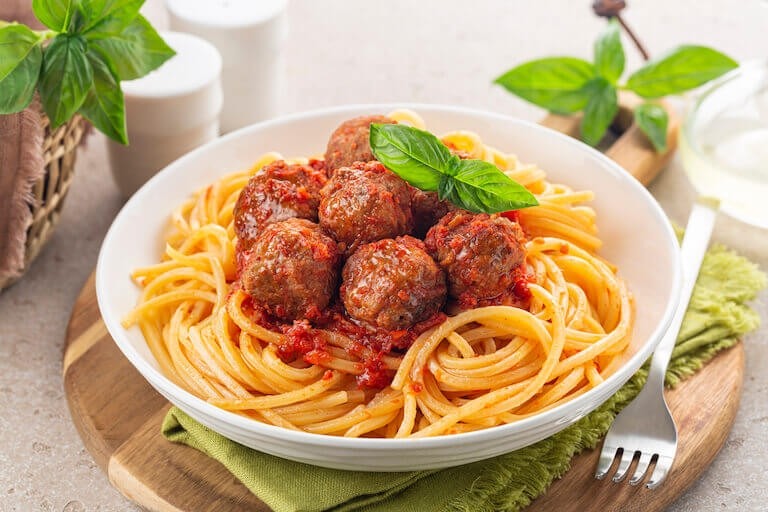
Although Italy has 20 regions, each with distinct culinary cultures, there is some consistency regarding what we deem “Italian” today.
The core elements of Italian cuisine include:
Simplicity and Local, Fresh Ingredients
True Italian cuisine features a few quality ingredients or foods on the plate. Handmade pasta cooked just so, tossed with a little olive oil—good olive oil, as Ina Garten might point out—a little quality shaved cheese, fresh basil, and some seasonal tomatoes. Many dishes use ingredients that hearken to the region where they originated.
Starch
Pasta, risotto, and polenta are three core starches in Italian cuisine. Pasta is usually a simple recipe of flour, water, and olive oil, but its shapes and uses are manifold—from the long, thin strips of spaghetti to sheets for lasagna or squares of ravioli waiting to be filled and pinched together. Risotto is a creamy rice dish typically made with Arborio or carnaroli rice; it can be tricky to make, as water or broth is added little by little instead of all at once in the beginning. And polenta is boiled cornmeal.
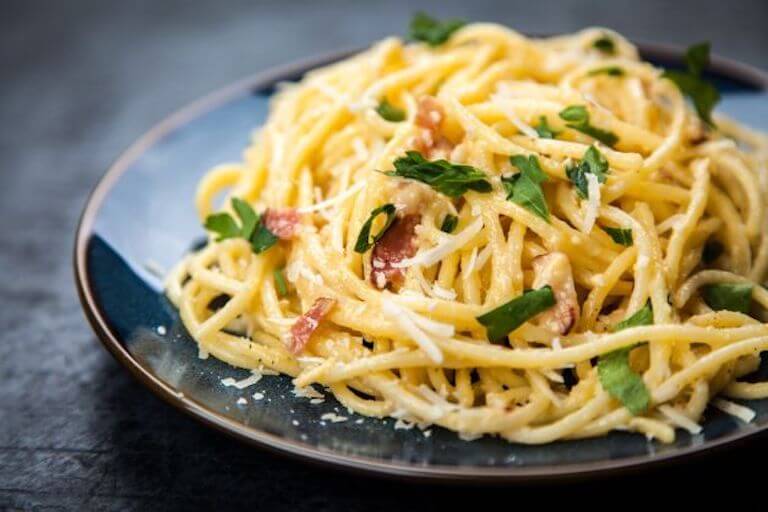
Authentic Italian dishes are simple, with just a few quality ingredients.
Extra Virgin Olive Oil
Deemed the highest quality olive oil, extra virgin olive oil is made by extracting the oil using only mechanical methods, no solvents or heat; it’s often referred to as cold-pressed. After extraction, the olive oil is graded. If it is fruity, has no defects and has a free acidity that is less than or equal to 0.8 , it is graded as extra-virgin, according to the North American Olive Oil Association. If it has minimal defects and a free acidity between 0.8 and 2.0, it is graded as virgin.
Balsamic Vinegar
Balsamic vinegar is a rich, dark vinegar made with grapes and aged like wine, in barrels. It is tangy and a little sweet, with a versatility that results in its showing up at any course: as a drizzle on antipasto, in a marinade or a stew, in salad dressing or drizzled over fish, boiled down to a syrup and used in a dessert, and even sipped as an aperitif (only if the quality is good; you don’t want to sip on cheap balsamic).
Basil, Oregano, Onions, Tomatoes
You can’t talk about Italian food without mentioning these core ingredients. Basil and oregano are aromatic herbs that work beautifully with olive oil and pair well with tomatoes. Onions add a depth of flavor, and tomatoes—pomodoros in Italian—are eaten as a snack, on pizza, and of course, are made into sauce.
Cheese, in Moderation
We can thank Northern Italy for much of the cheese that influences Italian cuisine. Soft cheeses include mozzarella or gorgonzola, while hard, grainy cheeses include fontina, a cow’s milk from the Italian Alps, and pecorino romano, a sheep’s milk. The popular parmigiano-reggiano is not to be confused with parmesan. Parmigiano-reggiano is highly regulated and can only bear the name if it comes from the provinces of Parma, Bologna, Mantua, Modena, or Emilia Romagna and has undergone rigorous testing that adheres to Protected Designation of Origin (PDO) standards.
Red and White Wine

Like Italian food, Italian wine is influenced by the country’s 20 regions, with styles unique to each. The country grows grapes from the northern mountainous region to the two islands in the Mediterranean Sea; as a very abbreviated rule of thumb, crisp white wines tend to come from the north, while full-bodied reds come from the south—and of course, there’s a variety in between. There’s also prosecco, a sparkling white wine that comes from northeastern Italy.
The overlap between Italian cuisine and the Mediterranean Diet
If you think Italian food is about sauces, pasta, meats, and cheese, you might be surprised to discover that authentic Italian cuisine actually bears a closer resemblance to the Mediterranean Diet and its emphasis on whole grains, vegetables, and fish.
More specifically, Italian cuisine naturally has Mediterranean influences and Sicily, of course, is an island in the Mediterranean Sea. Sicilian food is often associated with olives, seafood, and eggplant.
Traditional Courses
Late chef Michael Chiarello said: “Italian meals tend to have a reverse crescendo.” In other words, it starts with an array of items and gets simpler as it goes.
Courses can include:
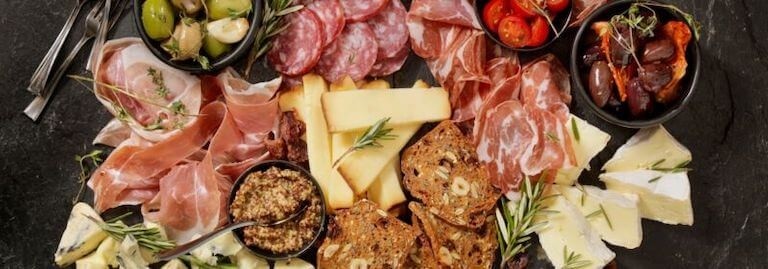
- Aperitivo—an appetizer, even something as small as olives, and possibly an aperitif
- Antipasti—often a charcuterie platter with a variety of vegetables (pepperoncini, mushrooms, and peppers being popular) and some cured meats, and/or sometimes bruschetta
- Primi—first course of hot food, which usually doesn’t have meat but may have fish; often a small pasta dish
- Secondi—basically, the main course, with meat and seafood options, accompanied by contorni (the veggies)
- Insalata—salad
- Formaggi e frutta—cheese and fruit
- Dolce—dessert
- Caffe—usually an espresso
- Digestivo—something like limoncello or grappa, which is said to aid in digestion.
Core Italian American Foods

Italian-American food is not the same as Italian food. The cuisine belongs in its own category, much in the same way that Tex-Mex is distinct from Mexican cuisine or a cousin who bears a familial resemblance but has their own distinct personality.
The core ingredients of Italian-American cuisine usually revolve around olive oil, garlic, red sauce, pasta, and cheese, with a wide range of variations inspired by the adjustments Italian Immigrants made when they arrived in the U.S.
“Ethnic Italians invented dishes like lobster fra Diavolo, spaghetti and meatballs, and veal parmigiana, and popularized foods like pizza and baked lasagna that had once been seen as overly foreign,” according to the book “Red Sauce.”
Here are 6 examples:
1. Spaghetti and Meatballs
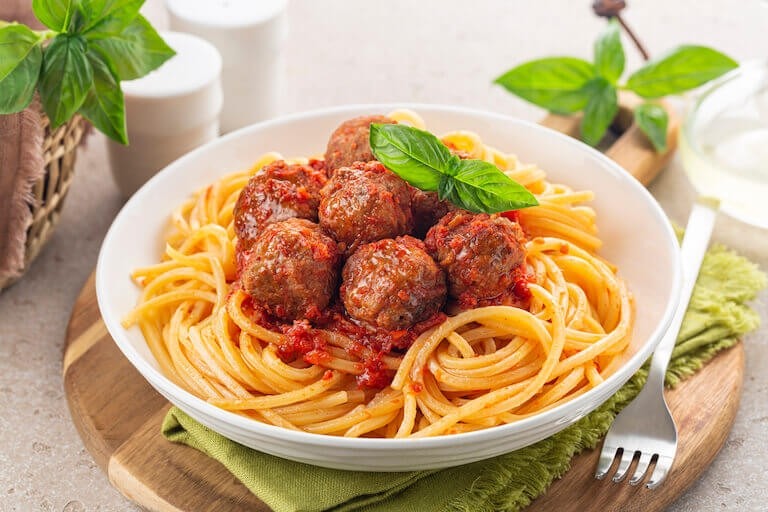
The pairing of meatballs with pasta (rather than meatballs on their own) distinguishes the dish as Italian American. The meatballs are also larger and usually include beef rather than veal and pork.
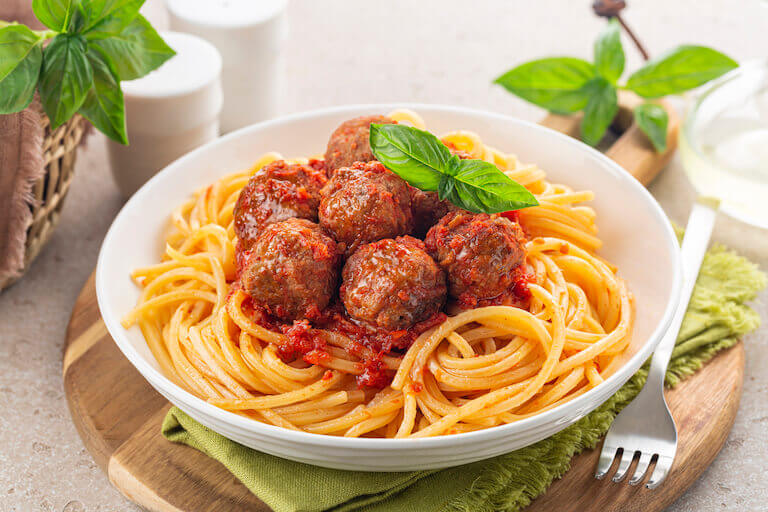
Spaghetti and meatballs is a quintessential Italian American dish.
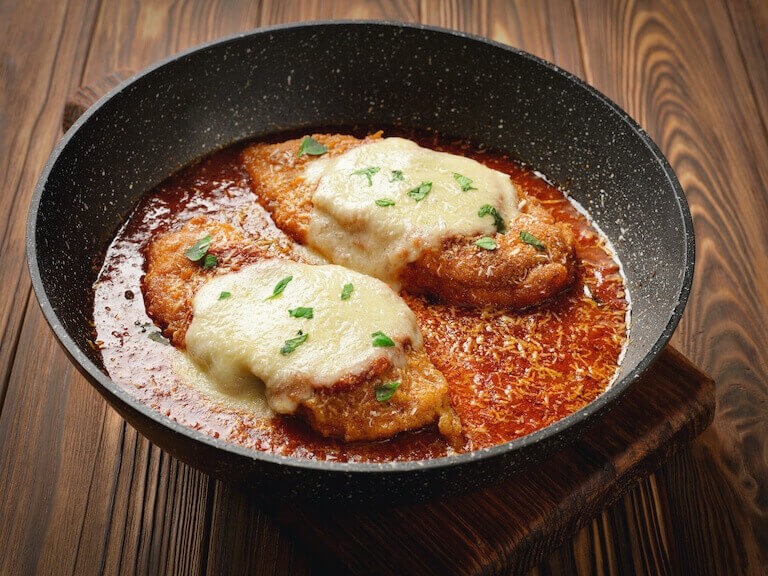
2. Chicken Parmesan
The traditional Italian dish would be eggplant parmesan, hearkening to the vegetables grown on farms and in families’ backyards. Eggplant wasn’t common in the U.S. in the early 1900s, thus Italian immigrants found a substitute.
3. Shrimp Scampi
Shrimp scampi is an adaptation; in Italy, cooks used mini lobster-like crustaceans, which weren’t available in the U.S., so Italian Americans instead used shrimp. The dish has evolved and the name, though it doesn’t make much sense—it’s akin to saying “shrimp lobster”—stuck.
4. Anything “Fra Diavalo”
Fra diavolo is a spicy red sauce typically paired with seafood. The Italian version is often considered arrabiata, which is thicker and paired with pasta, sans seafood.
5. Penne a la Vodka
“Vodka sauce”—a tomato sauce made with cream and vodka—is a relatively new invention, showing up in the 1970s and becoming popular in the 1980s. Its origins are debated but it is generally considered Italian American vs traditional Italian.
6. Baked Ziti
Baked ziti is considered an Italian American dish that’s a type of pasta al forno, or baked pasta. Although baked pasta exists in Italy, baked ziti specifically is considered an American version.
Today’s Influence on American Cuisine
Italian influences are everywhere, from simple weeknight spaghetti dinner to special occasions.
 HEALTHY MEALS
Leave a comment